

Excel vs. CMMS: Benefits of CMMS in Indian Maintenance

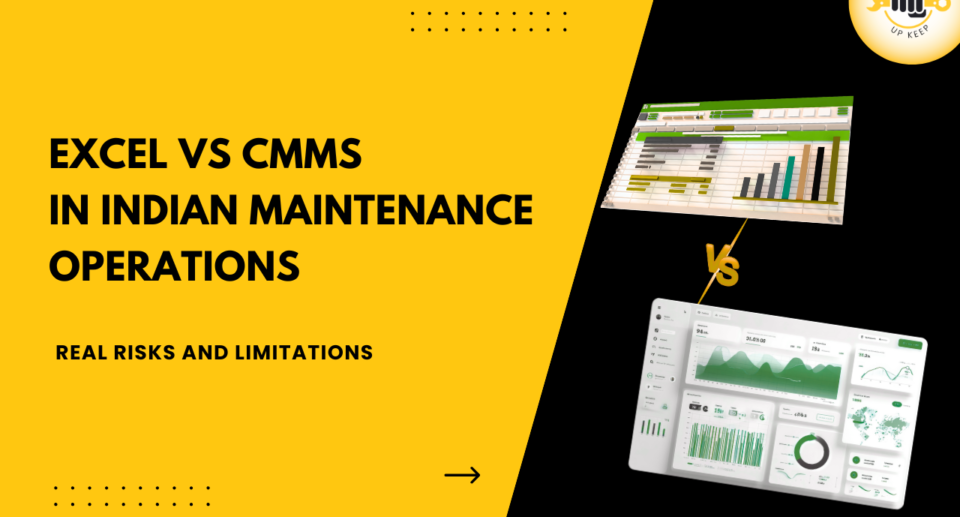
Across India’s industrial belt, from automotive component units in Chennai to textile mills in Tirupur, maintenance teams are still managing work orders, asset histories, and spare parts inventories in Excel spreadsheets. On the surface, this seems practical. Excel is familiar, widely available, and requires no new software training. But beneath this convenience lies a growing operational risk that becomes harder to ignore as plants scale, compliance tightens, and equipment complexity rises. This makes CMMS for Indian maintenance team unavoidable.
The reliance on Excel often stems from budget caution, digital hesitation, or limited exposure to modern alternatives. Yet as maintenance demands evolve, the limitations of spreadsheet-based systems become evident in real-world scenarios. Missed preventive tasks, duplicated entries, version chaos during audits, and zero visibility into asset performance trends are not hypothetical concerns. They directly impact uptime, safety, and cost control in daily operations.
This article breaks down why Excel falls short as a maintenance management tool in today’s Indian industrial context. It examines concrete risks, from data integrity failures to compliance gaps, and explains how CMMS for Indian maintenance system address these challenges without demanding massive investments or IT overhaul. The goal is not to dismiss Excel entirely, but to clarify where it stops being helpful and starts becoming a liability for any serious Indian maintenance system.
Why Excel Fails as a Long-Term Maintenance Management Tool
Excel operates as a static repository, not a living maintenance system. In fast-paced Indian plants where machines run 18 hours a day and technician shifts rotate frequently, maintenance data must be dynamic, accessible, and instantly updatable. Spreadsheets freeze information at a point in time. Once downloaded or copied, they drift from reality. A work order marked “completed” in one file may still show as open in another, creating confusion during shift handovers or emergency troubleshooting.
Preventive maintenance in Excel depends entirely on manual tracking. There’s no engine to interpret meter readings, runtime logs, or seasonal patterns to auto-schedule interventions. Technicians end up relying on memory or sticky notes, while critical assets like hydraulic presses or CNC spindles miss service windows. Over time, this accelerates wear, increases energy consumption, and raises the risk of catastrophic failure—costs that far exceed any perceived savings from avoiding digital tools.
Worse still, Excel offers no traceability. When an auditor asks for proof that a boiler was inspected every 90 days, the response is a scroll through unstructured rows with inconsistent formatting. There’s no user log, no timestamp validation, and no way to verify if the entry was made before or after the inspection actually happened. In a regulatory environment that’s tightening across sectors like pharma, food processing, and heavy engineering, this lack of audit integrity exposes plants to fines, shutdowns, or lost certifications. A true CMMS in India embeds compliance into daily workflows—not as an afterthought, but as a built-in discipline.
Hidden Costs That Make Excel More Expensive Than It Seems
Many plant managers view Excel as free, but the true cost hides in lost productivity, rework, and avoidable breakdowns. These indirect expenses often outweigh the modest investment in a proper maintenance platform.
- Time wasted on admin: Supervisors spend 3 to 5 hours weekly chasing updates, merging files, and formatting reports, time better spent on planning or coaching.
- Spare parts overstocking: Without real-time inventory tracking linked to work orders, teams over-order just in case, tying up working capital in unused stock.
- Reactive firefighting: Missed preventive maintenance schedules due to manual oversight lead to emergency repairs that cost 3 to 5 times more than planned interventions.
- Training inconsistency: New hires learn from fragmented templates, not standardized procedures, increasing human error risk.
- Downtime amplification: When a machine fails, diagnosing the issue takes longer because past failure modes are not tagged or searchable, only buried in comment cells.
- Leadership blind spots: Plant heads receive static monthly summaries, not live dashboards showing backlog trends or technician utilization, delaying strategic decisions.
- Data silos: Maintenance data lives separately from production logs, preventing cross-functional analysis such as linking machine vibration spikes to product defects.
- Audit preparation stress: Generating compliance reports requires manual filtering and validation, often taking days before an inspector arrives.
What Indian Maintenance Teams Really Need Beyond Spreadsheets
Indian maintenance operations need a solution that respects local realities—limited IT support, variable internet access, mixed digital literacy, and tight budgets—while delivering structured, reliable asset management. This is where a purpose-built CMMS for Indian maintenance steps in. Unlike generic enterprise software, modern CMMS platforms designed for the Indian context prioritize mobile access, offline functionality, and simple interfaces that mirror how technicians actually work on the shop floor.
A CMMS in India replaces error-prone spreadsheets with a centralized system where every asset, work order, spare part, and technician log lives in one connected environment. QR code tagging allows instant access to machine history using a smartphone camera. Work orders flow automatically from planning to execution, with real-time updates visible to all stakeholders. Inventory levels adjust instantly when parts are used, preventing both shortages and overstocking.
Most importantly, such systems grow with the plant. Starting with just 10 critical machines, an Indian maintenance system can demonstrate quick wins in reduced downtime and better compliance. As confidence builds, more assets and features can be added without disrupting ongoing operations. This phased, practical approach makes digital transformation achievable even for small and mid-sized manufacturers across tier-2 and tier-3 cities. Despite of that it is still lacking in Indian maintenance teams and for that one must understand why CMMS adoption in India is still slow?
Benefits of CMMS over Spreadsheet in Indian Maintenance Context
A CMMS delivers structured, scalable, and reliable maintenance management that spreadsheets simply cannot match in the Indian industrial setting. It transforms fragmented data into actionable intelligence while aligning with real-world constraints like intermittent connectivity and workforce readiness.
- Eliminates version control issues by providing a single, real-time source of truth for all maintenance activities
- Automates preventive maintenance scheduling based on usage, time, or condition triggers
- Enables mobile work order updates from the shop floor using basic smartphones
- Links asset history, spare parts consumption, and labor logs in one unified record
- Supports offline data entry with automatic sync when internet is restored
- Generates compliance-ready reports for statutory inspections without manual effort
- Provides live dashboards showing backlog, technician performance, and equipment health
- Reduces emergency breakdowns through proactive task tracking and historical trend analysis
Summing it up
Sticking with Excel for maintenance might feel safe today, but it is a growing risk to operational resilience. As Indian manufacturers face tighter margins, stricter regulations, and global competition, the cost of manual workarounds will only rise. The shift is not about replacing people with software. It is about freeing skilled technicians from paperwork so they can focus on what they do best: keeping machines running.
Digital maintenance tools like TeroTAM are within reach for Indian plants. With the right approach, pragmatic, phased, and grounded in real shop-floor needs, they deliver clarity, control, and confidence that no spreadsheet ever can.