


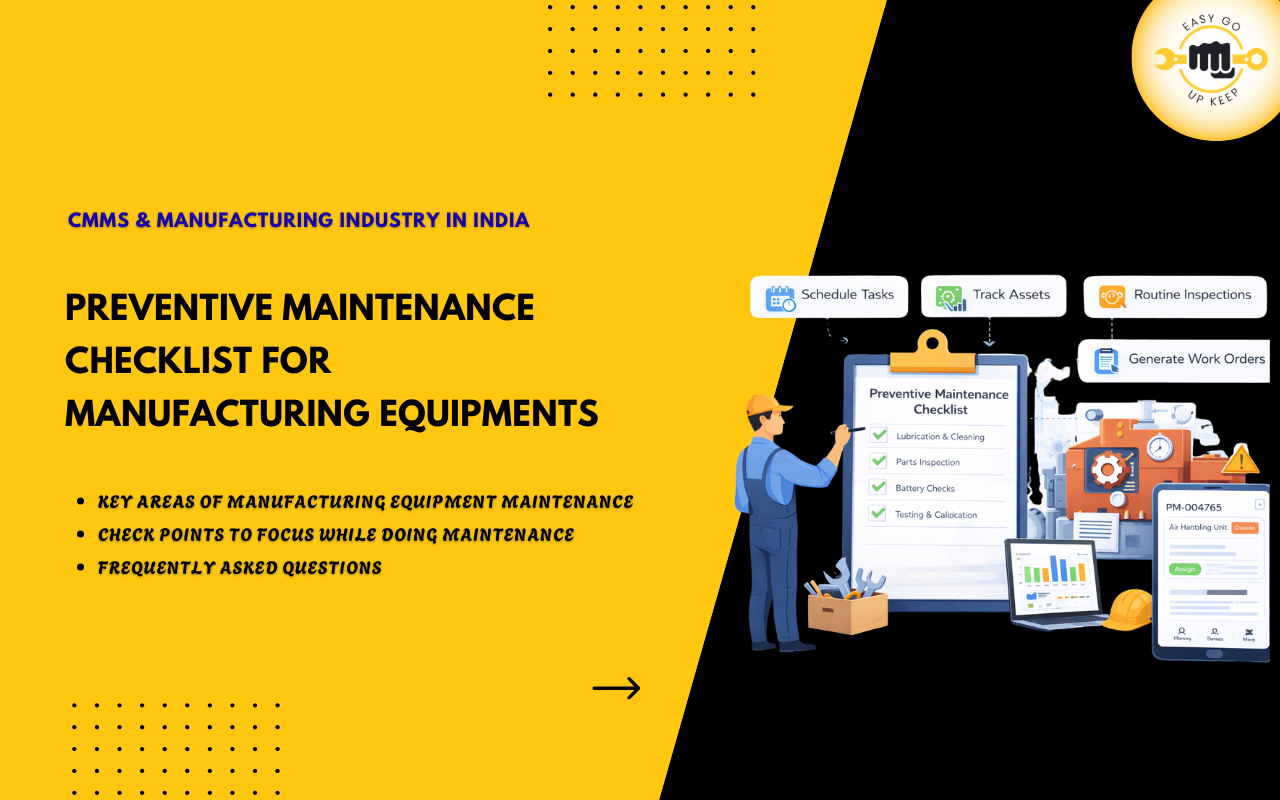
CMMS in India: What it is andHow does it help Indian manufacturing companies?


Indian manufacturing plants operate under tight production targets, high asset utilization rates, and limited shutdown windows. A single critical machine breakdown can halt an entire line, delay dispatch schedules, and increase overtime costs. In many mid-sized factories, maintenance coordination still depends on manual registers, Excel sheets, and verbal communication on the shop floor. This clearly points out the need of CMMS in India
As production complexity increases and compliance requirements tighten, this approach becomes unstable. A Computerized Maintenance Management System (CMMS) introduces structured control over maintenance planning, execution, asset history, and performance measurement.
This article explains what CMMS is, how it functions in a manufacturing environment, and how it improves operational reliability in Indian factories.
What is CMMS?
CMMS stands for Computerized Maintenance Management System. It is a centralized digital platform designed to manage maintenance operations, asset information, work orders, spare parts inventory, and performance analytics within an industrial environment.
From a technical perspective, CMMS acts as a maintenance execution and control system that:
- Stores complete asset hierarchy and equipment specifications
- Schedules preventive and periodic maintenance tasks
- Tracks breakdown events and corrective actions
- Maintains historical failure records
- Generates maintenance performance metrics
It differs from broader Enterprise Asset Management (EAM) systems, which typically handle asset lifecycle planning, procurement, depreciation, and capital investment decisions. CMMS focuses primarily on maintenance planning and execution within operational plants.
Core components of a CMMS system
A structured CMMS software in India generally includes the following modules:
1. Asset master database
This module defines plant hierarchy, such as
Plant → Department → Line → Machine → Sub-component.
Each asset record stores technical specifications, installation date, warranty details, service history, and maintenance frequency.
2. Work order management engine
Handles the complete lifecycle of maintenance activities, including request creation, approval workflow, job planning, technician assignment, execution tracking, and closure documentation.
3. Preventive maintenance scheduler
Automates recurring tasks based on time intervals (weekly, monthly, yearly), runtime hours, production cycles, or usage-based triggers.
4. Spare parts and inventory control
Tracks stock levels, minimum reorder quantity, supplier details, issue records, and part consumption history linked to specific assets.
5. Reporting and analytics dashboard
Generates performance reports such as MTBF, MTTR, maintenance cost analysis, preventive compliance rate, and downtime trends.
6. Mobile execution interface
Allows technicians to receive work orders, log job details, record breakdown causes, and upload photos directly from the shop floor.
CMMS in India : How It works inside a manufacturing plant
In a manufacturing environment, CMMS follows a structured operational workflow.
Asset structuring and hierarchy configuration
Every machine, auxiliary equipment, and sub-component is mapped into the system with a defined hierarchy. Proper hierarchy ensures accurate failure tracking and cost allocation. For example, a gearbox failure inside a packaging machine should be traceable to both the sub-component and the parent asset.
Preventive maintenance configuration
Maintenance planners define schedules such as:
- Time-based maintenance (every 30 days)
- Usage-based maintenance (after 500 operating hours)
- Condition-based triggers (vibration threshold alerts through sensor integration)
The system automatically generates work orders when triggers are met.
Work order lifecycle management
- Work request generation – Breakdown or inspection requirement is logged.
- Approval and prioritization – Supervisor reviews severity and assigns priority.
- Job planning – Required manpower, tools, and spare parts are defined.
- Technician assignment – Task is assigned with a deadline.
- Execution logging – Technician records repair time, parts used, and failure cause.
- Closure and documentation – Work order is closed with full history saved.
Data capture and historical record building
Every maintenance activity builds historical data. Over time, this enables:
- Identification of repeat failure patterns
- Reliability analysis
- Cost tracking per machine
This structured data foundation is where operational improvement begins.
Key maintenance metrics generated by CMMS
CMMS software in India enables manufacturing units to measure performance using quantifiable metrics.
1. MTBF (Mean Time Between Failures)
Formula: Total operating time ÷ Number of failures
Higher MTBF indicates improved equipment reliability. Historical failure data stored in CMMS allows calculation at the asset or line level.
2. MTTR (Mean Time to Repair)
Formula: Total repair time ÷ Number of repairs
MTTR reflects maintenance efficiency. Standard job plans and spare availability reduce repair duration.
Also Read: How Indian Plants are using MTBF and MTTR
3. Planned vs unplanned maintenance ratio
This indicates how much work is preventive compared to reactive breakdown repair. Mature plants aim for a higher planned maintenance percentage.
4. Maintenance cost per asset
Tracks labor cost plus spare consumption linked to each machine. Useful for replacement vs repair decisions.
5. Preventive maintenance compliance rate
Measures how many scheduled PM tasks were completed on time. Low compliance usually correlates with higher breakdown frequency.
6. Downtime analysis
CMMS tracks breakdown duration and root cause classification, helping management identify bottleneck machines.
Operational challenges in Indian manufacturing without CMMS
Factories operating without structured digital maintenance control often face:
- Lack of documented breakdown history
- Repeated failures due to missing root cause tracking
- Spare parts stock-outs during emergency repair
- Inconsistent preventive maintenance discipline
- No visibility of technician workload distribution
- Inability to measure maintenance performance objectively
Reactive firefighting culture becomes normal, which increases production instability and hidden costs.
How CMMS improves maintenance maturity levels
Maintenance operations generally evolve through stages:
Level 1 – Reactive maintenance
Machines are repaired only after failure.
Level 2 – Scheduled preventive maintenance
Tasks are planned periodically but often tracked manually.
Level 3 – Data-driven maintenance management
Failure history, cost analysis, and compliance metrics guide decisions.
Level 4 – Condition-based and predictive strategies
Data integration and analytics improve reliability planning.
CMMS enables transition from Level 1 or Level 2 toward Level 3 by introducing structured documentation and performance measurement.
Also Read: 10 Benefits of SaaS-Based CMMS software
Integration possibilities in Indian manufacturing plants
Modern CMMS platforms support technical integrations such as:
- ERP integration for procurement and inventory synchronization
- Barcode or QR tagging for asset identification
- IoT sensor integration for condition monitoring
- Multi-location plant management through centralized dashboards
These integrations help align maintenance with broader production and financial systems.
Technical criteria to evaluate CMMS software in India
When selecting CMMS software in India, manufacturing companies should assess:
- Customizable asset hierarchy configuration
- Failure code standardization support
- Multi-plant or multi-site architecture capability
- API integration options
- Role-based access control
- Audit trail and data security compliance
- Cloud-based vs on-premise deployment flexibility
- Scalability for growing asset base
Evaluation should focus on operational fit rather than just feature count.
Implementation considerations in Indian factories
Successful implementation depends on preparation and structured rollout.
Asset data cleansing
Existing equipment records must be standardized before migration.
Preventive maintenance master creation
All PM schedules should be documented clearly before system configuration.
Spare parts master alignment
Part codes, stock levels, and vendor details need consistency.
Technician training
Shop floor teams require structured onboarding and change orientation.
Pilot deployment
Rolling out in one department before full plant implementation reduces resistance and operational disruption.
Frequently asked questions
What is the difference between CMMS and EAM?
CMMS focuses on maintenance execution and control. EAM includes broader asset lifecycle planning, including financial management and procurement.
How long does CMMS implementation take in manufacturing?
Depending on plant size and asset volume, implementation may take 4 to 12 weeks.
Can CMMS integrate with ERP systems?
Most modern CMMS platforms support API or ERP integration for procurement and inventory synchronization.
Is CMMS suitable for small manufacturing units?
Yes. Cloud-based solutions allow small factories to start with limited assets and scale gradually.
How does CMMS improve MTBF?
By recording failure history and enforcing preventive maintenance schedules, CMMS reduces repeat breakdown frequency.
Conclusion
CMMS is not merely a digital logbook. It is a structured maintenance control system that transforms how Indian manufacturing plants manage equipment reliability, spare parts, technician accountability, and performance measurement.
Factories operating in competitive production environments require data-backed maintenance planning rather than a reactive repair culture. Implemented correctly, CMMS provides the operational framework necessary to stabilize production, reduce downtime, and improve maintenance efficiency across the plant.