
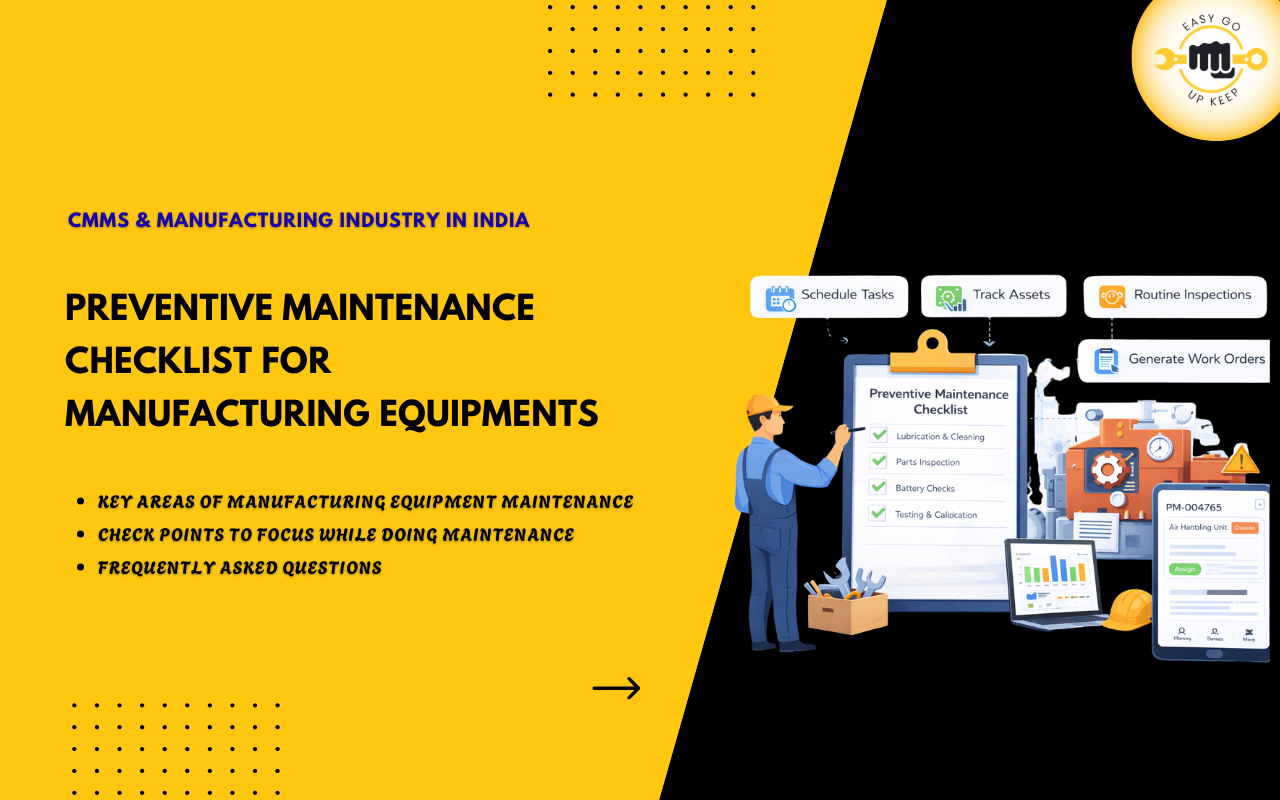
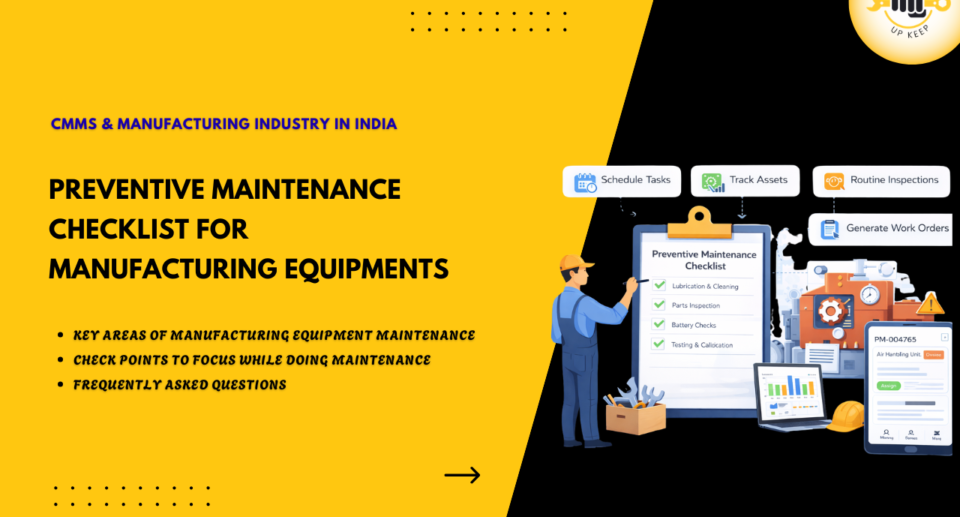
Preventive Maintenance Checklist for Manufacturing Equipment

Preventive maintenance has a big role in manufacturing industry and so as of preventive maintenance checklist. Manufacturing equipment operates under continuous mechanical load, vibration, temperature variation, and production pressure. Even a minor component failure in a critical machine can stop an entire production line. In many manufacturing plants, breakdown maintenance still dominates daily operations, where equipment is repaired only after a failure occurs.
Preventive maintenance offers a structured alternative. Instead of reacting to equipment failures, maintenance teams inspect, service, and adjust machines at predefined intervals. A preventive maintenance checklist helps standardize these inspections so that technicians can detect early signs of wear, overheating, misalignment, or lubrication issues before they lead to costly downtime.
This article explains how preventive maintenance works in manufacturing environments and provides a practical checklist framework for maintaining mechanical, electrical, and utility equipment.
What is preventive maintenance in manufacturing?
Preventive maintenance is a planned maintenance strategy where equipment inspections, servicing, and component replacements are carried out at scheduled intervals to reduce the probability of unexpected failures.
Unlike corrective maintenance, which begins only after equipment breaks down, preventive maintenance focuses on identifying potential problems early. Maintenance teams follow scheduled tasks such as lubrication, alignment checks, component inspection, and calibration to maintain machine reliability.
In manufacturing environments, preventive maintenance is commonly applied to:
- Production machinery
- Motors and drives
- Pumps and compressors
- Conveyor systems
- Electrical panels and control systems
- Plant utilities such as air compressors and cooling systems
By implementing preventive maintenance schedules, factories can improve equipment reliability and maintain consistent production output.
Why manufacturing plants require preventive maintenance checklists
Preventive maintenance programs involve numerous inspection tasks. Without structured checklists, technicians may miss critical steps or perform inspections inconsistently.
Standardization of maintenance tasks
Maintenance checklists ensure that all technicians follow the same inspection procedures across different machines. Standardization improves consistency and reduces the risk of incomplete inspections.
Early detection of equipment deterioration
Routine inspections help detect abnormal vibration, overheating, fluid leaks, or unusual noise. Identifying these conditions early allows maintenance teams to correct problems before a machine fails.
Improved equipment reliability
When machines are serviced regularly, critical components such as bearings, belts, seals, and filters remain in better condition. This improves the overall reliability of production equipment.
Better documentation of maintenance activities
Checklists also create maintenance records. These records help track equipment history, identify recurring issues, and support long-term reliability improvement.
Key components of a preventive maintenance checklist
An effective preventive maintenance checklist should contain clear and structured information to guide technicians during inspections.
Typical elements of a checklist include:
- Equipment identification and location
- Inspection frequency (daily, weekly, monthly, or quarterly)
- List of components to inspect
- Measurement parameters such as temperature or vibration
- Lubrication requirements
- Required tools and safety precautions
- Technician sign-off and inspection notes
Well-designed preventive maintenance checklists ensure that preventive maintenance activities are repeatable and properly documented.
Mechanical equipment preventive maintenance checklist
Mechanical equipment such as pumps, gearboxes, conveyors, and rotating machinery require regular inspection to maintain operational stability.
Bearing inspection
Bearings should be checked for unusual noise, overheating, and vibration. Excessive vibration or temperature often indicates lubrication failure or internal wear.
Lubrication condition
Technicians should verify lubrication levels and check for contamination. Insufficient lubrication increases friction and accelerates component wear.
Belt tension and alignment
Drive belts and couplings must maintain correct tension and alignment. Misalignment can cause uneven load distribution and premature equipment failure.
Gearbox oil inspection
Gearboxes should be inspected for oil level, contamination, and leakage. Oil condition plays a critical role in gear protection and smooth power transmission.
Fastener and mounting checks
Bolts, mounting brackets, and structural supports should be inspected to ensure they remain tight and stable during machine operation.
Vibration observation
Abnormal vibration often indicates imbalance, misalignment, or bearing damage. Early detection allows corrective action before catastrophic failure occurs.
Electrical equipment preventive maintenance checklist
Electrical systems control and power manufacturing equipment. Regular electrical inspections reduce the risk of overheating, short circuits, and equipment damage.
Motor insulation testing
Insulation resistance testing helps detect deterioration in motor windings. Low insulation resistance can lead to electrical faults.
Electrical connection inspection
Loose electrical connections generate heat and increase resistance. Tightening connections reduces the risk of overheating and power loss.
Panel temperature monitoring
Electrical panels should be checked for abnormal temperature levels. Excessive heat may indicate overloaded circuits or faulty components.
Control component inspection
Relays, contactors, and switches should be inspected for wear, dust accumulation, or malfunction.
Protection device testing
Circuit breakers, overload relays, and protective devices must be tested periodically to ensure they operate correctly during fault conditions.
Earthing system verification
Proper grounding protects both equipment and personnel from electrical hazards.
Utility system preventive maintenance checklist
Utilities support critical production processes and must operate reliably to maintain plant efficiency.
Compressed air systems
Maintenance tasks include:
- Compressor filter inspection
- Air leakage detection in pipelines
- Pressure regulator checks
- Moisture separator inspection
Air leaks in compressed air systems can significantly increase energy consumption.
Cooling systems
Cooling towers, pumps, and heat exchangers should be inspected for proper flow, water quality, and temperature stability.
Typical checks include:
- Coolant level verification
- Pump vibration inspection
- Heat exchanger cleaning
- Water treatment monitoring
Boilers and steam systems
Boiler systems require careful inspection to maintain safety and efficiency.
Checklist items include:
- Pressure gauge calibration
- Safety valve testing
- Steam trap inspection
- Condensate return system monitoring
Lubrication management checklist
Lubrication plays a critical role in reducing friction and preventing premature component failure.
Maintenance teams should verify:
- Correct lubricant type for each machine
- Lubrication frequency based on manufacturer guidelines
- Contamination levels in lubricants
- Condition of grease fittings and lubrication points
- Proper documentation of lubrication activities
Poor lubrication practices are a common cause of bearing and gearbox failures in industrial equipment.
Calibration and instrumentation inspection
Many manufacturing processes rely on accurate measurements from sensors and control instruments. Calibration ensures that these devices provide reliable data.
Preventive maintenance inspections should include:
- Pressure gauge calibration
- Temperature sensor accuracy verification
- Flow meter inspection
- Weighing scale calibration
- Control system instrumentation checks
Incorrect instrument readings can affect product quality and process control.
Preventive maintenance scheduling best practices
Preventive maintenance schedules should be carefully designed based on equipment criticality and operating conditions. There are some best practices for preventive maintenance checklist creation.
Common scheduling approaches include:
Time-based maintenance
Tasks are scheduled at fixed intervals such as weekly, monthly, or quarterly.
Usage-based maintenance
Maintenance is triggered after a machine reaches a defined number of operating hours or production cycles.
Condition-based monitoring
Sensors and monitoring systems detect changes in vibration, temperature, or pressure, allowing maintenance teams to act when abnormal conditions appear.
Combining these approaches improves equipment reliability while avoiding unnecessary maintenance tasks.
Role of maintenance software in managing preventive maintenance checklists
Managing preventive maintenance manually can become difficult as the number of assets grows. Maintenance software helps organize and automate preventive maintenance activities.
Digital maintenance systems support:
- Automated preventive maintenance scheduling
- Digital inspection checklists for technicians
- Work order generation and task assignment
- Maintenance history tracking
- Performance reporting and analytics
These systems allow maintenance managers to monitor preventive maintenance compliance and ensure that scheduled tasks are completed on time.
Common mistakes when implementing preventive maintenance
Many preventive maintenance programs fail because of poor implementation practices.
Excessive maintenance tasks
Performing too many inspections can overload maintenance teams and reduce efficiency.
Lack of accurate equipment data
Incomplete equipment records make it difficult to design effective maintenance schedules.
Inconsistent checklist usage
Technicians may skip inspection steps if procedures are not standardized.
Poor documentation
Failure to record maintenance activities prevents analysis of recurring problems.
Lack of technician training
Maintenance teams must understand inspection procedures and equipment behavior to perform effective preventive maintenance.
Frequently asked questions
What is a preventive maintenance checklist?
A preventive maintenance checklist is a structured list of inspection and servicing tasks that technicians perform regularly to maintain equipment reliability and prevent unexpected failures.
How often should preventive maintenance be performed?
The frequency depends on equipment type, operating conditions, and manufacturer recommendations. Tasks may be scheduled daily, weekly, monthly, or based on operating hours.
Which equipment requires preventive maintenance in factories?
Most production machinery, motors, pumps, compressors, conveyors, and electrical systems require regular preventive maintenance inspections.
Can preventive maintenance reduce machine downtime?
Yes. Preventive maintenance helps identify potential equipment problems early, reducing the likelihood of sudden breakdowns.
What is the difference between preventive and predictive maintenance?
Preventive maintenance follows scheduled intervals, while predictive maintenance uses sensor data and condition monitoring to detect equipment failure risks.
Conclusion
Preventive maintenance allows manufacturing plants to maintain equipment reliability through planned inspections and servicing. Structured checklists help technicians detect early signs of wear, overheating, vibration, and component deterioration before failures occur.
When supported by proper scheduling and digital maintenance systems, preventive maintenance programs improve equipment availability, reduce downtime, and support stable production operations in manufacturing environments.